 Caelvard
Can trees block a satellite TV signal? How to check your dish’s view
Work out whether a tree or roof crosses the path to your TV satellite before moving a dish that used to work.
Yes. A tree can block reception when its branches or leaves cross the path from the dish to the satellite. A tall tree elsewhere in the garden may have no effect. Check the compass direction first, then compare the height of the obstacle with the satellite’s elevation.
Check the view from dish height
Start at the actual dish position, or as close as you can get safely from the ground. Use your satellite’s azimuth to identify the direction across the garden. Now look up along its elevation angle. A tree sitting below that line may leave the path clear. A roof edge much closer to the dish can cross it even if it looks shorter than the tree.
Keep the phone close to the dish’s height for this check. Standing on a raised deck several metres to the side can make a blocked gap look clear. Also allow for branches moving in wind and new growth. DISH installation guidance on obstructions
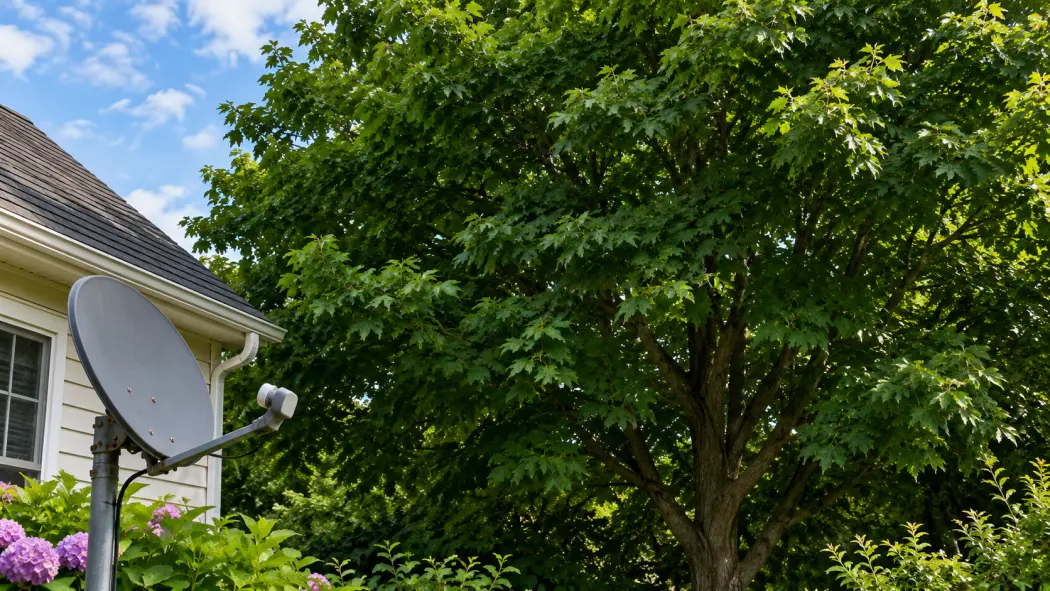
Estimate whether the treetop is in the way
Suppose the dish is 2 metres above level ground, the tree is 10 metres away horizontally, and the satellite elevation is 30°. Over those 10 metres, the signal path rises about 5.8 metres (10 × tan 30°). At the tree, the centre of the path is therefore about 7.8 metres above ground. A 9-metre crown directly on that bearing crosses the line. The same tree several metres off to one side might be clear.
Use this as a rough check. Sloping ground changes the height comparison, and a branch just grazing the line leaves little margin. Where you can choose between two ground-level mounting spots, compare both views before fixing the dish in place.
If reception changes with the seasons
A dish that works through bare branches in winter may lose quality once leaves return. Note the receiver’s quality reading on the same channel on a clear day and see whether the target line passes through the canopy. A clear view with poor reception points you back to the alignment and receiver checks. A persistent obstruction is a reason to ask an installer about a different mounting spot.
Check the sky before you move the dish
Choose your TV satellite in SatAlign and use its line-of-sight guidance from each candidate spot. You can compare a gap beside the tree with the view from the original mount before anyone unbolts the dish.
Get SatAlign on the App Store